My WHOOP recently surfaced this insight:
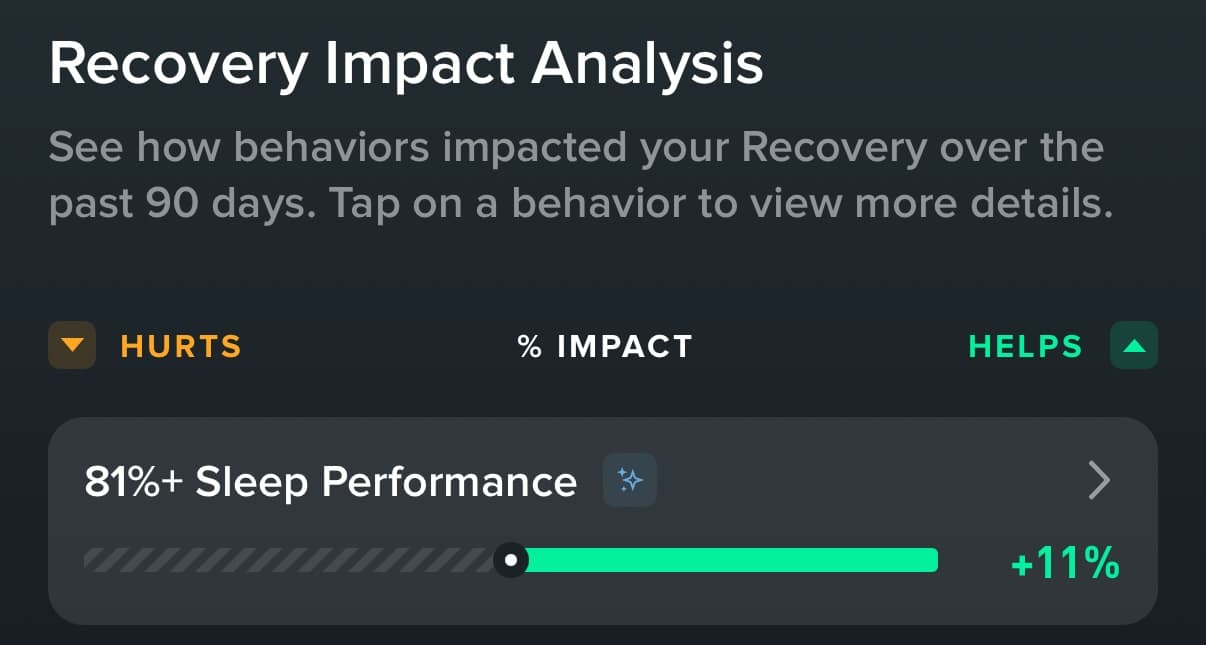
At first glance, it's an interesting insight (albeit a bit obvious). But it triggered some alarm bells in me. WHOOP's ecosystem is built on proprietary metrics like Strain and Recovery - black-box algorithms that distill complex data into a single score. They're not entirely mysterious though; we do know that Sleep Performance is an input for the Recovery score.
"WHOOP calculates your recovery on a scale of 0 to 100% during your sleep, looking at your heart rate variability (HRV), resting heart rate, respiratory rate, SpO2, sleep performance, and skin temperature to see how your body is adapting to physiological and psychological stress. The biggest influence is by far your HRV but it also considers your health, behaviours, stress levels, hydration, and more."
— WHOOP, 2026
If an output (recovery) is dependent on an input (sleep performance), is predicting that an improvement in the input (sleep) leads to an improvement in the output (recovery) actually a "behavioural insight" or is it just defining the underlying relationship baked into the algorithm?
This felt overstated, so I pulled my data from the WHOOP API to find out.
Understanding recovery
Recovery is a composite score, between 0 and 100, comprising Heart Rate Variability (HRV), Resting Heart Rate (RHR), Sleep Performance, amongst other factors. Roughly it's meant to tell you how ready you are to perform.
To understand what's driving it, I computed correlations between the key inputs.
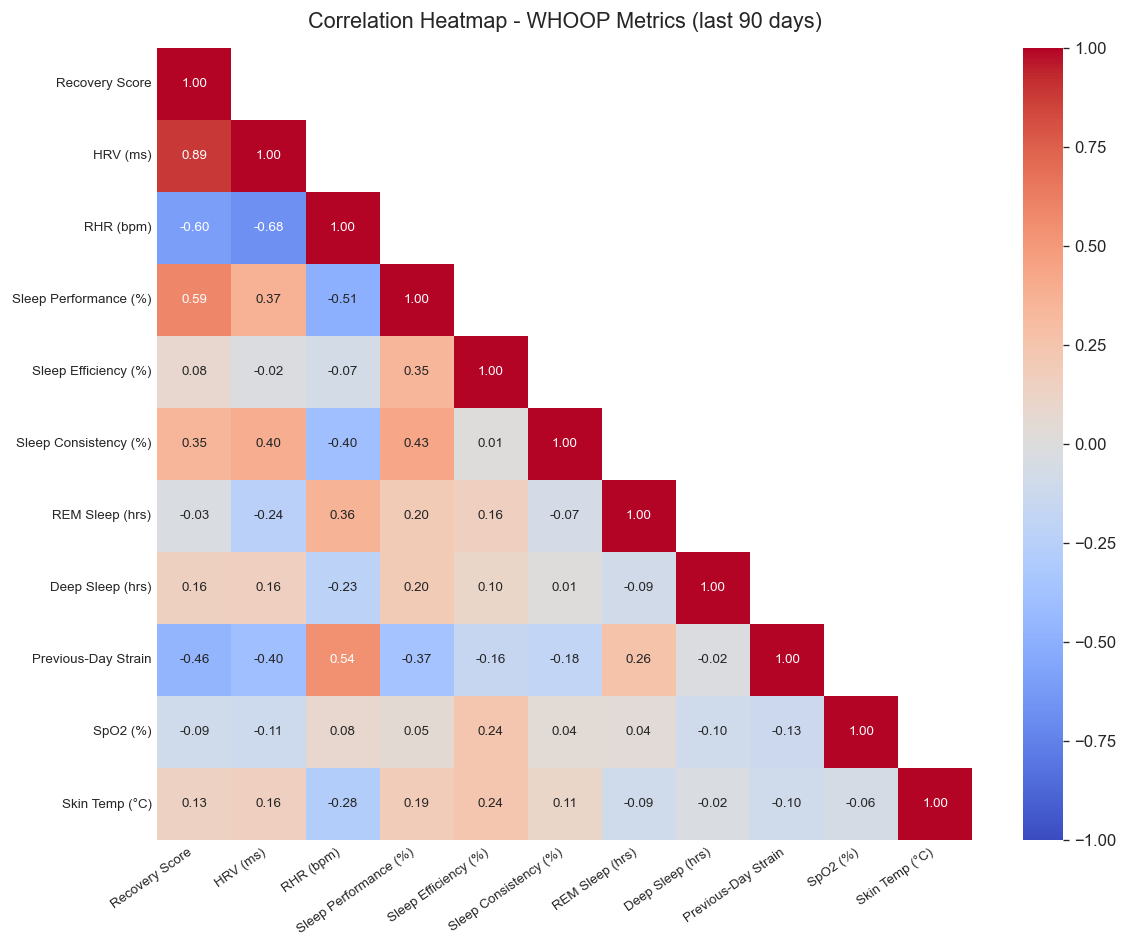
Clearly HRV and recovery are highly correlated (0.89), which is hardly surprising. So, too, are the correlations for RHR and recovery (-0.60) and sleep performance and recovery (0.59).
All three inputs correlate with recovery as expected, given they feed the formula directly. But HRV and RHR aren't what WHOOP is surfacing as a behavioural insight here. If WHOOP's behavioural insight was that an elevated HRV or reduced RHR leads to a better recovery, you'd say "duh, by definition" - it's not a behavioural insight. That's my gripe here with their sleep-recovery claim.
I'm more interested in knowing how much of the recovery from better sleep goes through physiology - improved HRV and RHR - versus how much the recovery score is simply rewarding a higher sleep input directly.
Isolating the sleep contribution
To confirm this, I need to show that the formula adds recovery points for sleep directly - regardless of what HRV and RHR are doing - and put a number on it.
I stripped out the HRV and RHR contribution using a linear regression model, then regressed the remaining recovery points against sleep performance alone, leaving the residuals. The residuals also contain other minor formula inputs - SpO2, respiratory rate, skin temperature - but sleep is the largest of these, so the figure is a reasonable approximation.
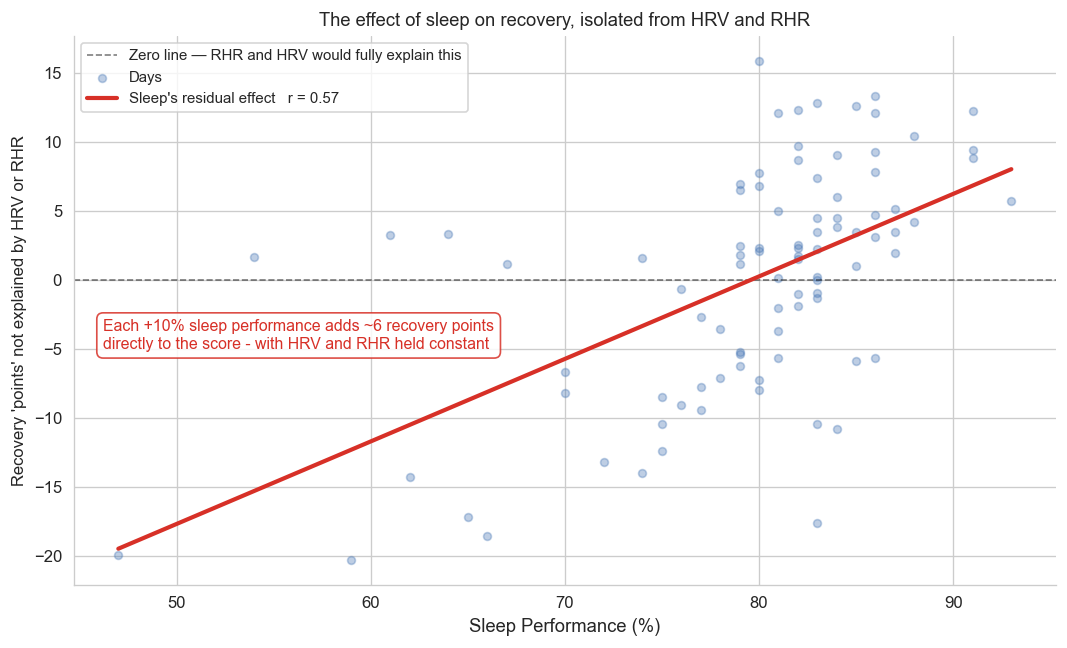
The relationship is clear. Each 10% improvement in sleep performance adds around 6 recovery points directly to the score - with HRV and RHR held constant. Two nights with identical HRV and RHR but a 10% sleep difference will produce recovery scores 6 points apart, not because the body is in a different state, but because the formula received a higher input.
So how much of WHOOP's headline gap does this account for?
Breaking down the gap
On good sleep nights (81%+), my average recovery was 73.3. On the other nights, 58.1 - a gap of 15.2 points. WHOOP headlines this as "11%"; the difference is likely how they normalise the gap, but the direction is the same.
We now have a way to split that gap. Good sleep nights averaged 84% sleep performance; poor nights averaged 73%. That 11-point difference in sleep score directly accounts for around 6.6 recovery points - not because HRV or RHR were better, but because recovery received a higher input from sleep.
Of the 15.2-point gap:
- 6.6 points (43%) - the formula directly rewarding good sleep, independent of physiological state.
- 8.6 points (57%) - a genuine physiological difference: HRV and RHR were also better on those nights.
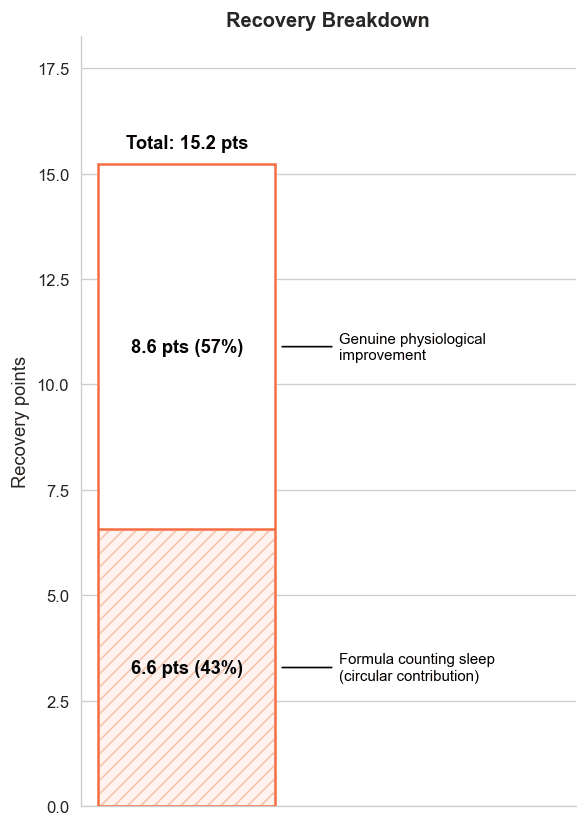
The 57% is real - better sleep does improve HRV and RHR, and that was never the question. But 43% of the gap is structural: it would exist on any night with an 11-point sleep difference, regardless of how the body actually felt. The headline figure is nearly half formula arithmetic. Strip out the formula arithmetic and the genuine improvement is closer to 6%, not 11%.
Is sleep performance the only culprit?
No. The same logic applies to any WHOOP insight where the behaviour touches the sleep score - anything that improves sleep score raises recovery directly.
Consistent sleep timing is a clear example: more consistent timing → better sleep quality → higher sleep score → circular contribution to recovery.
| Behaviour | WHOOP claim | Recovery (with / without) | Recovery gap (pts) | Sleep % (with / without) | Sleep gap (%) | Sleep contribution to recovery (pts) | Sleep contribution to recovery (%) |
|---|---|---|---|---|---|---|---|
| Consistent wake time | +5% | 69.7 / 64.5 | 5.2 | 81.7 / 78.1 | 3.6 | +2.2 | 42% |
| Consistent bedtime | +4% | 69.2 / 65.0 | 4.2 | 81.8 / 78.1 | 3.7 | +2.2 | 52% |
Both show 42-52% of the recovery gap coming directly from the sleep formula, not from physiological differences captured by HRV and RHR. The pattern is the same.
These behaviours are all one step upstream of the same problem. What about behaviours with less of a structural link to sleep?
The comparison that settles it
The clearest test is behaviours with less structural link to sleep performance - where any recovery difference should come almost entirely from physiology.
For me, there are a few things I track each day: using a standing desk, stretching, commuting and working late. Working late may seem to have a link to sleep - a later bedtime, potentially less rest. But the data disagrees, my sleep score is virtually identical on those nights (79.8% vs 79.5%) and is actually marginally higher on the nights I work late. Recovery is also higher when working late - likely a confound from more structured, active days rather than the late work itself.
Standing desk, stretching and commuting all have a less obvious link to sleep, although none are strictly independent.
| Behaviour | WHOOP claim | Recovery (with / without) | Recovery gap (pts) | Sleep % (with / without) | Sleep gap (%) | Sleep contribution to recovery (pts) | Sleep contribution to recovery (%) |
|---|---|---|---|---|---|---|---|
| Worked late | +1% | 72.4 / 64.1 | 8.2 | 79.8 / 79.5 | 0.3 | +0.2 | 2% |
| Stretching† | +3% | 69.9 / 66.2 | 3.6 | 80.6 / 79.5 | 1.0 | +0.6 | 17% |
| Standing desk† | +5% | 76.7 / 65.6 | 11.1 | 81.9 / 79.3 | 2.6 | +1.5 | 14% |
| Work commute | +3% | 71.2 / 63.3 | 7.9 | 81.5 / 78.3 | 3.2 | +1.9 | 24% |
† Small sample: stretching n=7, standing desk n=9.
The recovery differences in this group are largely physiological. Sleep-adjacent insights carry a 40-52% formula premium. Independent ones don't. That's not coincidence - that's the structure showing through.
So what does this mean?
The original gripe was simple: if sleep performance is an input to the recovery formula, then a WHOOP insight saying "better sleep → better recovery" is partly just the algorithm describing itself. The data confirms it.
Of WHOOP's headline 11% improvement, 43% is the formula directly rewarding a higher sleep input - not a genuine change in physiological state. The more honest figure is closer to 6%. The same pattern holds for other sleep-adjacent behaviours: 40-52% of their reported recovery gains run through the formula. Independent behaviours - things you do during the day with no structural link to sleep - show 2-24%. The formula inflates exactly where you'd expect it to if the circularity is real, and doesn't where you wouldn't.
WHOOP's insight isn't wrong. Better sleep genuinely does improve HRV and RHR - the 57% is real. But the headline figure is part tautology. Knowing which part is which is the more useful insight.